Most people picture tea, not vineyards, when they think of Yunnan. Yet in the province's far north-west, where the Himalayan foothills drop into the great river valleys, small terraced plots grow Chardonnay, Cabernet Sauvignon and more at serious altitude. This guide explains Yunnan wine and shows where to taste it at Vinflow Wine Bar & Bistro in Singapore.
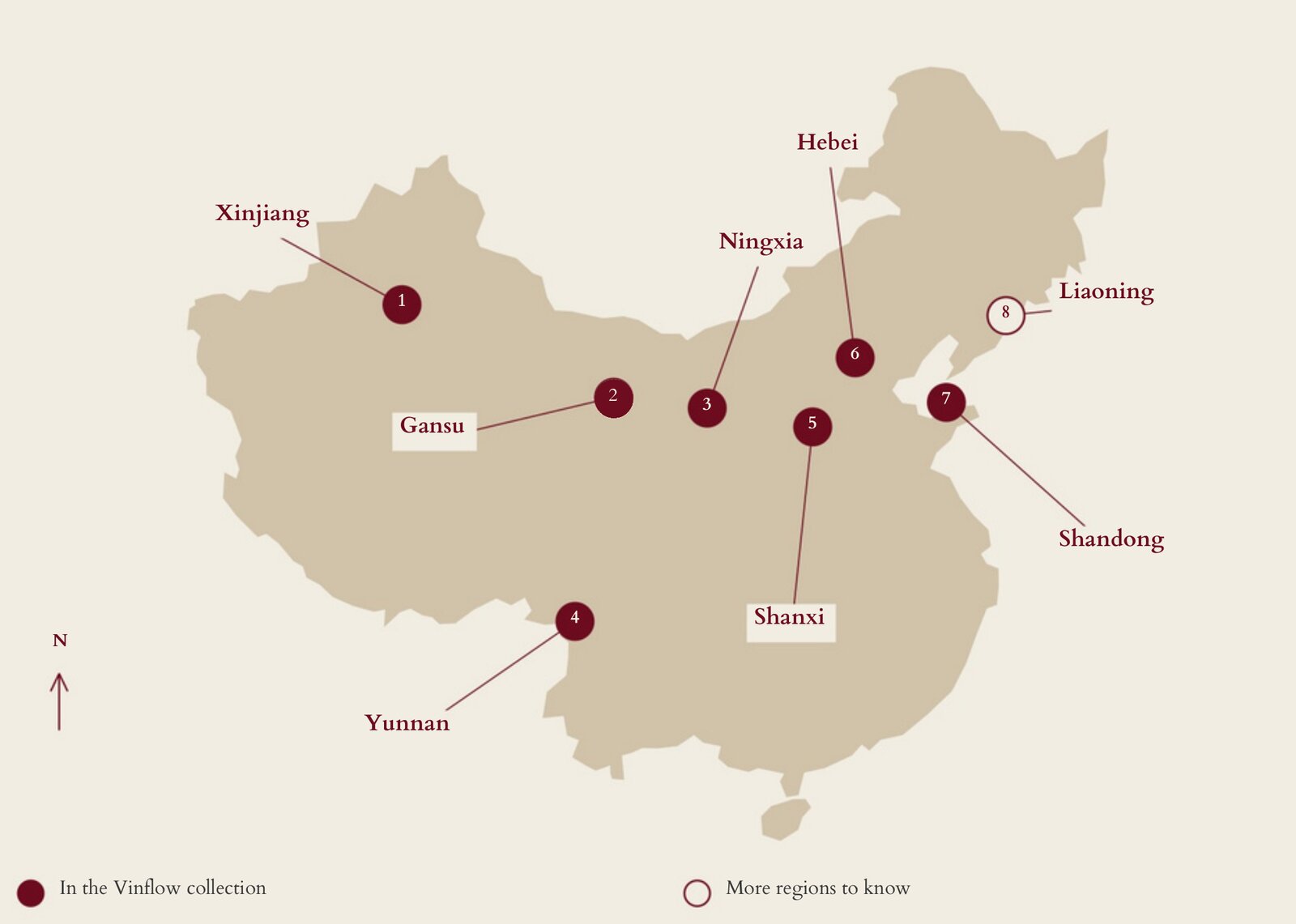
Yunnan is one part of our wider Chinese wine collection in Singapore, which brings together 32 Chinese wines from 15 wineries across seven regions. It is also the region that looks least like the rest of Chinese wine, so it rewards a closer look.
Where is Yunnan wine grown?
Yunnan lies in south-west China, bordering Tibet, Myanmar, Laos and Vietnam. The wine story belongs mainly to its north-western corner. In 2014, Jancis Robinson described Deqin county, in Diqing prefecture, as a remote corner of the Himalayan foothills at the western limit of the province, about 35 km from the Tibetan border. Shangri-La is the prefecture's capital, which is why you will see its name on wine labels and estate names across the area.
The vineyards are not the broad, flat estates of Bordeaux or Napa. They are small, scattered plots on the few terraces flat enough to cultivate in the narrow valleys of the upper Mekong (Lancang) and Yangtze (Jinsha) rivers. Her report notes that local government began encouraging Tibetan farmers to switch from barley to vines from 1999, and that the vineyards were small and dispersed because of the mountainous terrain.

Why is Yunnan called high-altitude wine country?
Altitude is the headline. In the villages Jancis Robinson visited above the Mekong, she reported vineyards between about 2,200 and 2,700 metres. Bauzuan, one of the producers on our list, describes terraced vineyards at more than 2,200 metres in the Himalayan highlands of Yunnan, planted in small plots on steep mountain slopes. Those figures are specific to these producers and villages rather than a rule for the whole province, but they explain why "high altitude wine China" so often points to Yunnan.
What does height do for a vine? A few general effects are well understood:
- Strong light, cool nights. Thin air lets in bright sunshine by day, and temperatures drop sharply after dark, which helps grapes keep freshness while they ripen.
- Thick skins. Jancis Robinson noted that grapes grown at these heights had skins thick enough to travel well, an effect often linked with intense colour and flavour in mountain wines.
- Dry mountain air. She reported summer rainfall of roughly two-thirds that of Bordeaux and drier autumns, with fewer pests and diseases than are common in wetter regions.
There is a contrast with northern China too. Ningxia's winters are so cold that growers commonly bury their vines each year, as we explain in our Ningxia wine guide. Jancis Robinson pointed out that Yunnan's highlands avoid both that winter freeze and the wet summers of eastern coastal regions such as Shandong, which is a large part of why wine people got interested in this far corner of the country.
Is there a history of wine in Yunnan?
Yes, and it is a good story. French missionaries who settled along the Mekong in the 1800s are reported to have brought grapevines for communion wine; the village of Cizhong, in Deqin county, is known for its Catholic church and a grape called Rose Honey, which Jancis Robinson describes as a non-vinifera variety still made into sweet reds. That heritage sits alongside a much newer chapter. According to her report, modern wine-growing in the area took off after 1999, with Cabernet Sauvignon, Merlot and a little Chardonnay now the main plantings in the highland villages she visited.
Larger companies have also taken an interest in the area, but the wines on our list come from the producers below.
Where to try Yunnan wine in Singapore
Vinflow lists six Yunnan wines from three producers. Tasting cues below are the published profiles for each wine, not our own tasting assessment. Wine selection, vintages and availability are subject to change, so please check the full wine list or ask the team on the day.
Bauzuan (宝庄)
The name to know if you are searching for Bauzuan. Its vineyards are terraced at more than 2,200 metres in the Himalayan highlands of Yunnan, planted in small plots on steep mountain slopes. Wines on our list:
- Célèbre White 2022 (Chardonnay) — citrus, peach and fennel.
- ALLOFME Rosé 2023 (Cabernet Sauvignon) — red berries and citrus.
- Célèbre Red 2018 (Cabernet Sauvignon) — blackcurrant and dark fruit.
Shangri-La Wine Estate (香格里拉酒业)
A Yunnan producer whose highland vineyards around Shangri-La combine strong sunlight and mountain soils. On our list:
- Sacred Legend Chardonnay 2022 — citrus blossom, peach and gentle oak.
Petit Mont (寸山)
A Chinese winery with vineyards in several regions, including Yunnan near Baima Snow Mountain, Ningxia’s Helan Mountain East and Yili in Xinjiang. Two Petit Mont wines on our list carry the Baima Snow Mountain name:
- Baima Snow Mountain Deqin Cuvée Prestige Chardonnay 2024 — citrus and orchard fruit.
- Baima Snow Mountain Yanjing 2022 (Cabernet Sauvignon, Merlot) — blackcurrant and plum.
Petit Mont’s Tianshan Mountain Cuvée Prestige Cabernet Sauvignon 2021 comes from Xinjiang rather than Yunnan, so we have left it out of the six.
How to taste Yunnan wine: a simple plan
Three Chardonnays and two Cabernet Sauvignon-based reds make a neat comparison, because you are tasting familiar grapes grown at altitude:
- Line up the Chardonnays. Célèbre White 2022, Sacred Legend 2022 and the Baima Snow Mountain Deqin Chardonnay 2024 all point to citrus, with peach, blossom or orchard fruit in the published notes. Compare how each producer reads the same grape.
- Add the rosé. ALLOFME Rosé is Cabernet Sauvignon, so it is a lighter, red-berried take on a grape usually met as a red.
- Finish with the reds. Célèbre Red and Baima Snow Mountain Yanjing both list blackcurrant. For a contrast, try Ningxia Cabernet alongside; our guide to Chinese Cabernet Sauvignon shows how it varies by region.
- Bring food. Order a few shareable plates and let the wines share the table. Pairings are only suggestions; see our guide to Chinese wine and food pairing.
Want more context first? Our guide to Chinese wine regions places Yunnan alongside the others, and the most acclaimed Chinese wineries is a good next read. If you are not sure Chinese wine is for you, start with is Chinese wine good?
Try Chinese wine by the flight
Yunnan wines are not part of the current Premium Chinese Wine Flight, but the flight is an easy way to taste Chinese wines from three other regions. It is a +$20++ top-up to regular-priced free-flow ordered between 5 and 8 pm, with four different Chinese wines, one glass each: Kanaan Riesling 2024 (Ningxia), Tiansai Skyline of Gobi Chardonnay Muscat 2023 (Xinjiang), Grace Vineyard Recalling The Year 2025 (Shanxi) and Fei Tswei Lava Cabernet Franc 2021 (Ningxia). Refills are not included, promotional packages are excluded, and the line-up is subject to change. See our promotions page for free-flow details. Planning a group evening? Our private events page has details.
Plan your visit
Vinflow is at 55 Keong Saik Road, #01-01, Singapore 089158, open daily from 3 pm. Reserve through OpenTable or message us on WhatsApp. Ask which Yunnan wines are available that day, since selection and vintages change. Wine service is for guests of legal drinking age; please drink responsibly.
Frequently Asked Questions
Yunnan wine in Singapore
Is Yunnan a wine region?
Yes. Yunnan is in south-west China, and wine grapes are grown in its far north-west highlands around Deqin and Shangri-La, in the narrow valleys of the upper Mekong and Yangtze rivers, on terraces at roughly 2,200 to 2,700 metres in the areas Jancis Robinson described. Vineyards are small and scattered.
What does Himalayan wine from Yunnan taste like?
Styles vary by producer and vintage. The published profiles of the Yunnan wines at Vinflow point to citrus, peach and orchard fruit in the whites, red berries in the rosé, and blackcurrant, plum and dark fruit in the reds. These are published tasting cues, not our own assessment.
Which Yunnan wines can I try at Vinflow in Singapore?
Vinflow Wine Bar & Bistro lists six Yunnan wines: three from Bauzuan, one from Shangri-La Wine Estate and two Baima Snow Mountain wines from Petit Mont. Selection, vintages and availability are subject to change, so check the wine list or ask the team.
Why does altitude matter for Yunnan wine?
At high altitude the days are bright and the nights are cool, which can help grapes ripen while keeping freshness. Yunnan's highland vineyards also sit at a low latitude, and the dry mountain air is generally kinder to vines than the humid summers of China's eastern coast.